


 06 de marzo de 2025
  0 comentarios
Algunos de los métodos de apriete de pernos más comunes incluyen el patrón de estrella, el patrón de estrella modificado y el patrón de cuadrante.
Estos métodos ayudan a lograr una distribución uniforme de la presión y a evitar fugas en las conexiones de bridas.
Sin embargo, existen algunas restricciones clave y pasos de instalación que debes seguir.
Toda conexión de brida exitosa comienza con una preparación adecuada. Omitir estos pasos puede provocar fallas en la unión, independientemente de la secuencia de apriete elegida.
Comience limpiando a fondo todas las caras de las bridas para asegurar un sellado adecuado. Examine cada superficie cuidadosamente para detectar rebabas, abolladuras o daños que puedan comprometer el sellado. Revise todos los pernos y tuercas para detectar daños en las roscas o corrosión, y reemplace cualquier componente que presente signos de desgaste.
Aplique el lubricante adecuado a todas las roscas para reducir la fricción y evitar el desgaste durante el apriete. Apriete a mano cada tuerca hasta que quede bien ajustada contra la superficie de la brida y verifique que la junta esté correctamente alineada. Antes de comenzar la secuencia, asegúrese de que todas las herramientas de torsión estén calibradas y listas para usar.
Los diferentes conteos de pernos requieren progresiones de torque específicas para lograr un sellado adecuado:
| Recuento de pernos | Primer pase | Segundo paso | Tercer paso | Pase final |
| 4-8 pernos | 30% | 60% | 100% | Circular |
| 12+ pernos | 20% | 40% | 80% | 100% |
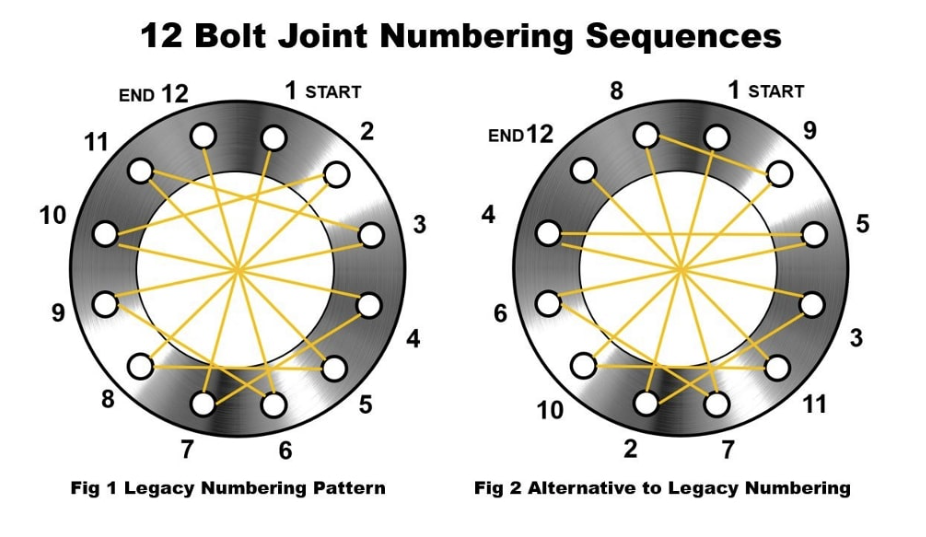
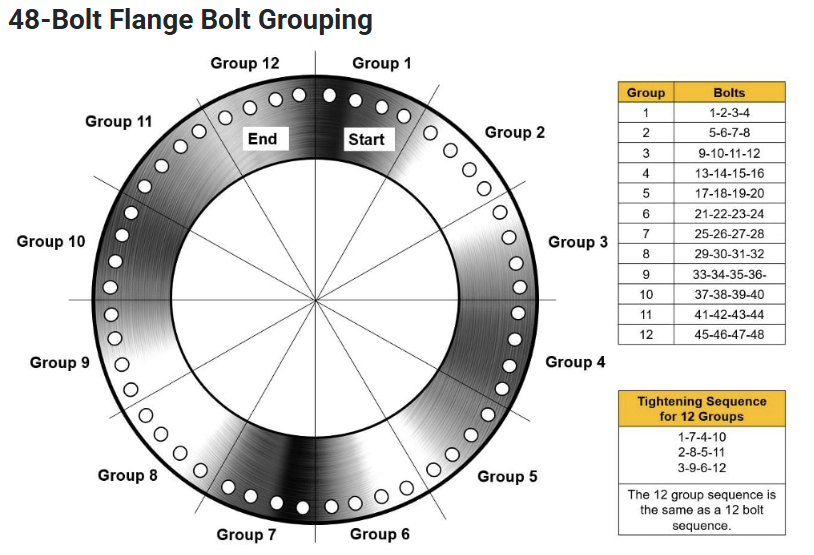
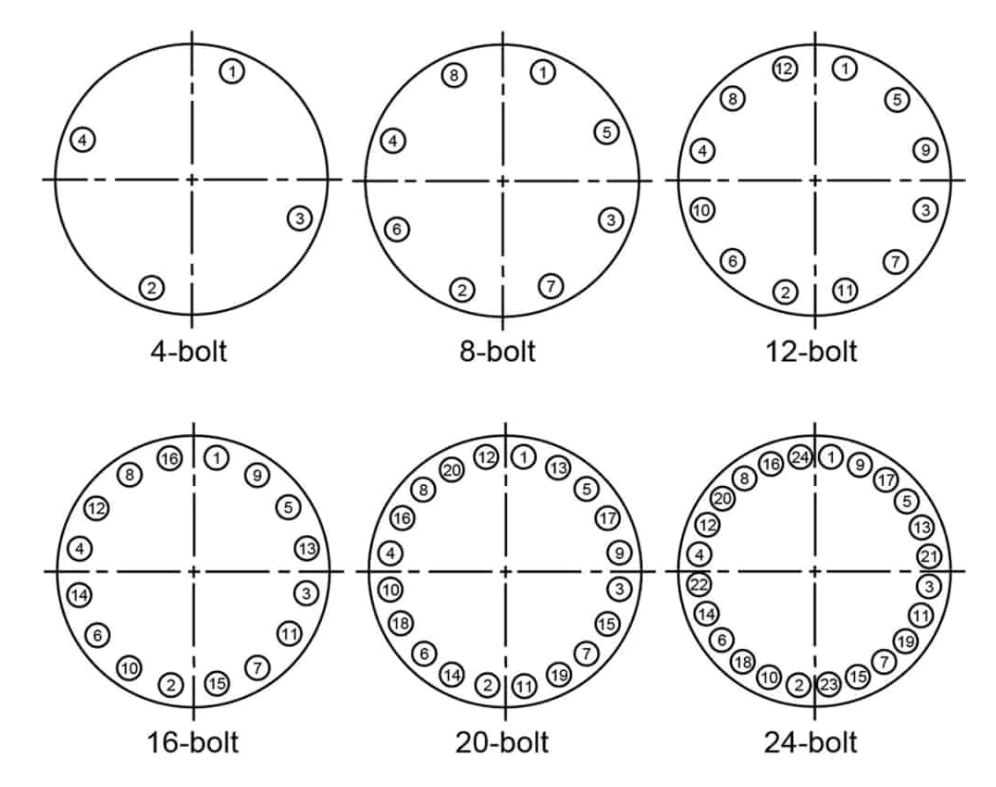
Desde 1938, el patrón de estrella ha sido el estándar industrial para bridas ASME de todos los tamaños. Este método funciona eficazmente con la mayoría de los tipos de bridas y materiales de junta.
Comience aplicando torsión inicial a los pernos opuestos en una secuencia diagonal, aumentando gradualmente la presión con cada pasada hasta alcanzar la especificación final.
El patrón de estrella modificado se basa en el método tradicional pero aumenta la carga del perno más rápidamente, lo que lo hace ideal para instalaciones más grandes.
Los técnicos siguen la secuencia de estrellas mientras aumentan el torque de manera más agresiva entre juegos de pernos, ahorrando tiempo sin sacrificar la integridad de la unión.
El patrón de cuadrante ofrece máxima eficiencia para bridas de gran diámetro manteniendo al mismo tiempo la integridad de la unión durante todo el proceso de ajuste.
Los instaladores aprietan los pernos secuencialmente dentro de los cuadrantes de la brida, lo que reduce el movimiento transversal de la brida y ahorra un tiempo significativo durante la instalación.
La selección de la secuencia correcta de apriete de pernos afecta el tiempo de instalación, la confiabilidad de la unión y los requisitos de mantenimiento.
Tenga en cuenta estos factores clave al elegir su método:
Bridas pequeñas con 12 pernos Las conexiones de mayor tamaño funcionan mejor con el patrón de estrella tradicional, mientras que las conexiones de mayor tamaño se benefician de los métodos de estrella o cuadrante modificados. El número de pernos en la brida influye directamente en el método más eficiente.
Sus limitaciones de tiempo podrían obligarle a optar por métodos más rápidos, pero las aplicaciones de sellado críticas exigen enfoques probados. Tenga en cuenta la experiencia de su equipo de instalación, ya que algunos métodos requieren técnicos más cualificados.
Los diferentes tipos de juntas funcionan mejor con secuencias específicas, y la presión de operación influye en la selección del método. Considere también la frecuencia con la que necesitará acceso para mantenimiento a la conexión.
Fabricante desde 2011 · Exportamos a más de 50 países · Acero inoxidable SS304, 316L, dúplex 2205 y 2507 · Hasta DN4000 · Normas ASME, DIN, GOST y JIS · Certificaciones ISO 9001 y PED · Cantidad mínima de pedido: 1 unidad · Cotización en 24 horas
Obtén un presupuesto directamente de fábrica →La secuencia correcta de apriete de pernos garantiza conexiones de bridas confiables y evita costosas fallas en las uniones.
Tomarse el tiempo para comprender sus requisitos específicos le ayudará a elegir entre el patrón de estrella tradicional, el patrón de estrella modificado o los métodos de cuadrante. Para obtener orientación sobre los métodos y especificaciones de instalación de bridas, visite longanbrida.com o Ponte en contacto con nuestro equipo técnico.
Recomendaciones y restricciones de la secuencia de apriete de pernos

 13 de junio de 2026 0 comentarios
 12 de junio de 2026 0 comentarios
 11 de junio de 2026 0 comentarios
 +86-15727821389 +86-15355931307
 Teléfono:
 +86-15727821389
 Correo electrónico:
 mft@longanflange.com
mft001@longanflange.com
 DIRECCIÓN:
 620 Kongo Mingzhu Road, Yongxing Street, distrito de Longwan, ciudad de Wenzhou, provincia de Zhejiang, China.


